

AI in Gaming 2025: 5 Powerful Innovations That Are Changing Game Design Forever
The deployment of Artificial Intelligence (AI) in gaming has evolved from speculative ambition to a robust, transformative force actively redefining both the technological and experiential dimensions of interactive entertainment. By 2025, AI has emerged as a foundational paradigm in game development, permeating every stratum of the ecosystem—from procedural asset generation and environmental design to emergent game play mechanics and adaptive storytelling. Its widespread adoption is reshaping industry conventions, catalyzing a shift from static, pre-programmed frameworks toward responsive, learning-driven environments that align with developers’ creative objectives and dynamically engage with players’ behavioral patterns.
Outlined below are five critical innovations illustrating how AI in gaming is fundamentally re-engineering both design practices and paradigms of user engagement.
1. Cognitive NPCs and Emergent Behavioral Architectures
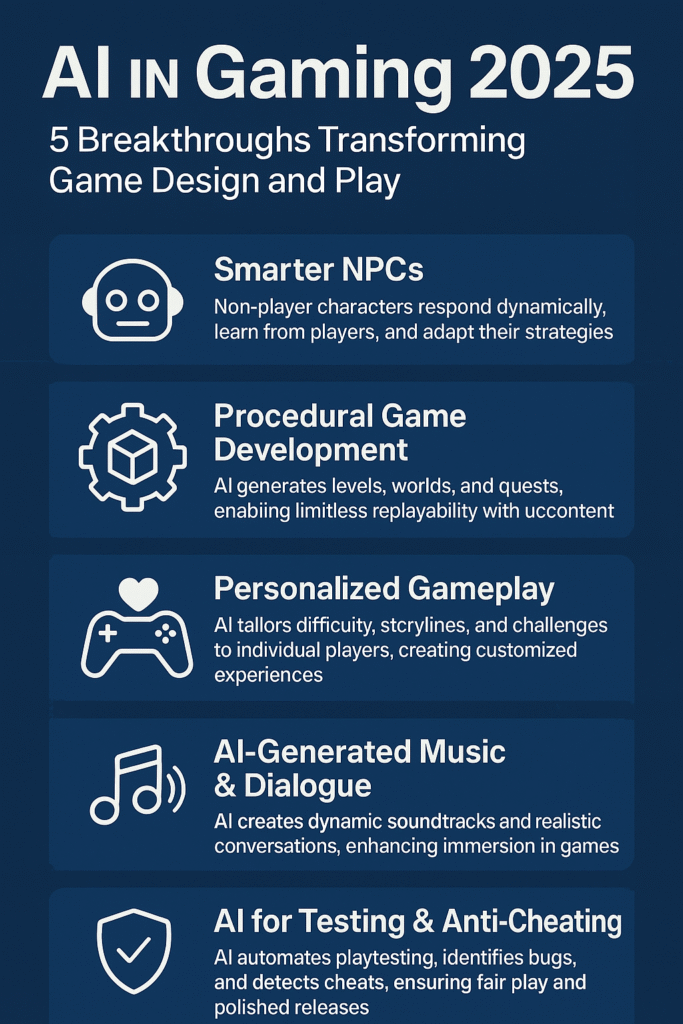
Historically, non-playable characters (NPCs) have functioned as deterministic constructs, bound by rigid scripting and limited interactivity. In contrast, AI-driven NPCs in 2025 leverage real-time decision-making algorithms, reinforcement learning, and memory architectures that allow them to evolve in parallel with player behavior. These agents exhibit contextual adaptability, strategic foresight, and persistent behavioral modeling, generating emergent narrative systems that are neither strictly authored nor wholly stochastic.
This transformation repositions NPCs as dynamic collaborators in the ludic narrative process—entities capable of co-constructing a unique and reactive player journey, thereby enabling more sophisticated and deeply immersive storytelling.
2. Algorithmic Design and Automated Development Pipelines
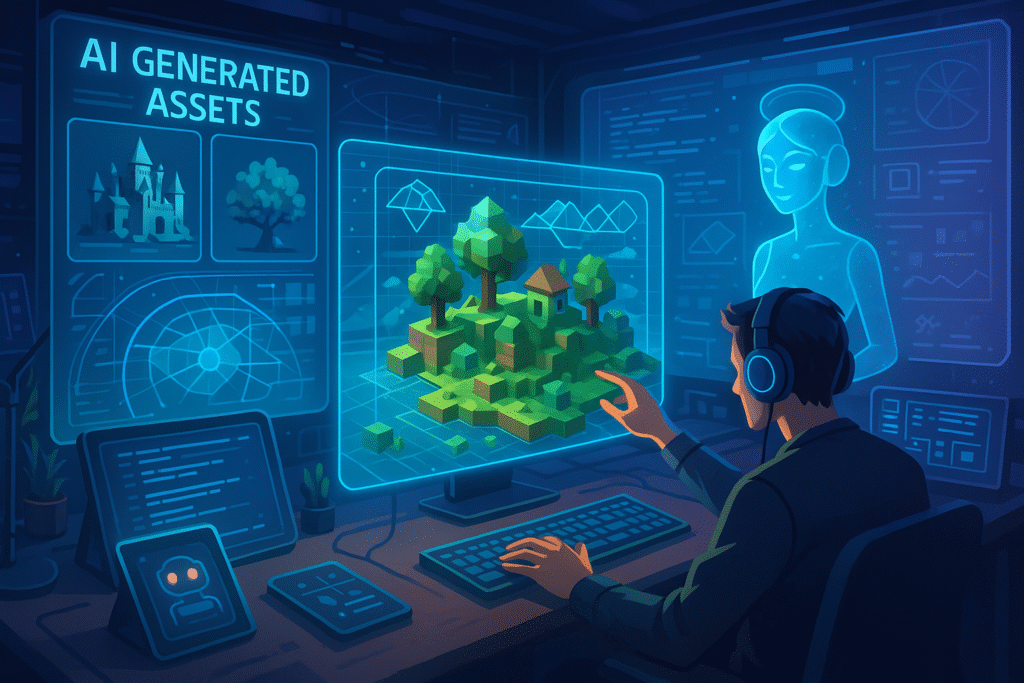
The integration of AI in procedural content generation—spanning terrain synthesis, architectural layout, character morphology, and dialogue scripting—has revolutionized scalability in game production. Tools employing generative adversarial networks (GANs), natural language processing (NLP), and automated rigging workflows now facilitate the rapid generation of complex environments and multifaceted narrative branches.




This paradigm shift reduces both development cycles and overhead while expanding creative latitude. Independent and mid-tier studios can now deliver experiences with a fidelity and complexity once exclusive to AAA developers, thereby democratizing the production landscape.
3. Behavioral Analytics and Personalized Ludo narrative Frameworks
Among the most sophisticated applications of AI in gaming is its capacity to interpret and respond to player behavior in real time. Advanced machine learning models analyze telemetry, input cadence, and user engagement patterns to modify variables such as enemy difficulty, mission progression, narrative direction, and character relationships.
The result is an anticipatory ludonarrative experience, wherein the narrative structure conforms uniquely to each player’s cognitive style and decision-making profile. This personalization cultivates deeper emotional investment and elevates player agency, exceeding the limitations of traditional branching narratives.
4. Generative Audio and Synthetically Produced Dialogue
Innovations in generative voice synthesis and adaptive audio engineering—enabled by platforms such as ElevenLabs and Suno AI—are revolutionizing the acoustic dimension of gameplay. These systems incorporate affective computing, sentiment analysis, and real-time input monitoring to dynamically modulate vocal tone, narrative pacing, and musical structure based on player interaction.
Such tools not only facilitate AAA-quality auditory production at lower cost but also enhance global accessibility via automated localization and multilingual output. The net result is a more emotive and contextually coherent soundscape that significantly augments narrative immersion.
5. Predictive Quality Assurance and Autonomous Cheating Mitigation
AI’s impact is equally profound in back end systems, particularly within quality assurance (QA) and real-time integrity enforcement. Predictive models simulate thousands of game play scenarios to identify latent bugs, structural imbalances, and performance bottlenecks prior to public release, improving stability and user satisfaction.
Simultaneously, AI-driven anti-cheat mechanisms leverage pattern recognition and behavioral analytics to identify anomalous actions indicative of botting or exploitation. These systems ensure equitable multiplayer experiences while reducing the reliance on manual moderation and post-hoc punitive measures.
Conclusion: A Paradigm Shift in the Semiotics of Play
AI in gaming has transcended its auxiliary status to become a primary epistemological agent in the evolution of interactive media. By re-configuring the developer-player-system triad, AI introduces new syntax’s of interaction in which game design becomes a semiotic dialogue and game play an interpretive performance.
This convergence of algorithmic intelligence and artistic intent raises critical ontological and ethical questions: How does one preserve authorial integrity within procedural generated content? To what extent should adaptive systems mediate narrative coherence?
Despite these tensions, the trajectory is unmistakable: in 2025, AI is no longer behind the curtain—it is the dramatize, the stage, and, increasingly, the co-actor.
Call to Action:
We invite researchers, developers, and media theorists to engage in this evolving discourse. Share your reflections, critiques, or examples of AI-driven innovation in gaming in the comments below. Subscribe to our platform for continued exploration of the ethical, aesthetic, and systemic dimensions shaping AI-powered design.


Leave a Comment